 Nidhi Thakur
 7 min
7 min


Key Takeaways
Houston's online retail scene has quietly turned into one of the more competitive markets in the country. New D2C brands are launching every month, established retailers are pouring budget into their websites, and shoppers are searching Google before they search Amazon. If you run an online store here, ranking on page one isn't optional anymore, it's the difference between steady orders and a website that just sits there.
This guide walks through why SEO services in Houston for e-commerce websites matter right now not the textbook version, the real one. We'll get into what typically breaks on e-commerce websites, which SEO services move the needle, and what to ask before you sign with an agency.
Paid ads gets your brand visible the moment you turn them on and disappear the moment you turn them off. SEO works differently, it compounds. A product page that ranks well in month six is usually still ranking (and often ranking better) in month eighteen, without you paying per click for it.
For Houston retailers specifically, there's a local layer to this too. Shoppers searching "buy furniture Houston" or "Houston boutique clothing online" behave differently than someone typing a generic product name into Google. They're closer to buying, and they're comparing local options against national ones. Generic SEO tactics don't always translate well here. SEO services for eCommerce websites need to be built around the store, the catalog, and the city not a one-size-fits-all template. That's why more retailers are choosing eCommerce SEO services Houston agencies understand.
Also Read: Things to Cater in SEO for Fashion eCommerce

Online stores fight a different battle than a typical business website. A five-page service site is easy to keep clean. A store with 3,000 products is a different animal entirely, and most SEO problems trace back to how the catalog itself is structured. That's why the most effective Houston SEO services treat catalog structure as the starting point, not an afterthought.
Colour options, size filters, and sorting parameters can quietly generate hundreds of near-identical URLs for the same product. Search engines see this as duplicate content, and instead of ranking your best version, they get confused about which one to show and sometimes ranking none.
A store just copies the manufacturer's description and drops it straight onto the product page. Saves time, sure. But so does every other retailer selling that same product, which means Google's now looking at ten, twenty, sometimes fifty pages that all say the exact same thing. When that happens, nobody wins the ranking, because there's nothing for Google to differentiate.
Large product category means heavier image loads, more scripts, and slower load times. Google has made page experience a ranking factor for years now, and a slow-loading category page will bleed both rankings and conversions at the same time.
Bots only crawl so many pages per visit it's a budget, not a guarantee. On most stores that budget gets wasted on filtered URLs, dead promo pages, and out-of-stock listings nobody's buying. Meanwhile your actual money pages get crawled less, so new products and updates take longer to show up in search.
Identify technical and content gaps preventing your e-commerce website from ranking, attracting qualified shoppers, and generating consistent organic revenue growth.
Audit My Store
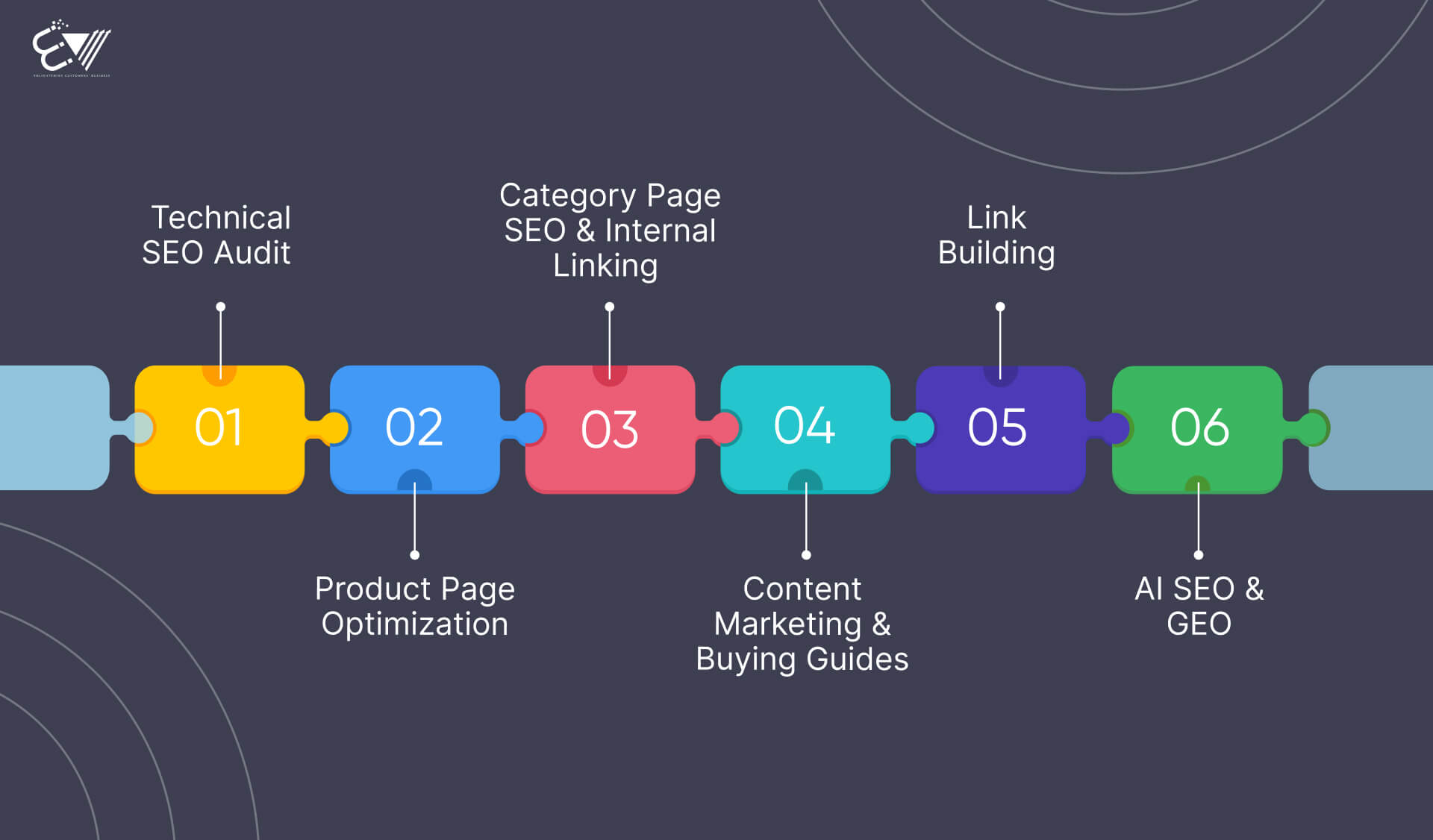
A generic SEO checklist won't fix any of this. What works looks more like a build-out than a to-do list, and it usually starts here.
First things first somebody must go in and figure out what's broken. Crawl errors, weird canonical tags, dead internal links, a site structure that made sense three redesigns ago but not anymore. Skip this step and everything you do after it is basically guesswork.
Each product page needs its own title tag, a meta description someone would click on, product copy that isn't lifted from a sheet, and schema markup so Google can pull in pricing, reviews, and stock status right into the search result. Small stuff individually, but it adds up fast across a full catalog.
Category pages quietly carry a lot of the traffic on most stores, and they're almost always the most ignored part of the site. Getting the internal linking right between categories, subcategories, and related products isn't just a "nice to have" it's how Google figures out what your catalog is.
Blog content and buying guides target the research phase of the shopping journey think "best patio furniture for Houston summers" capturing traffic before a shopper even knows which product they want.
Earning backlinks from relevant, authoritative sites still carries real ranking weight. For local Houston stores, this can include local business directories, press coverage, and partnerships with Houston-based bloggers or influencers.
Search behaviour is shifting toward AI-generated answers and chat-based search tools. Generative Engine Optimization (GEO) makes sure product, and brand information is structured in a way that AI search tools can pull from an increasingly important part of any modern eCommerce SEO strategy.
Also Read: AI SEO for eCommerce Beyond the Buzzword and Into Real Results
Even if your store only sells online, local signals still matter as long as you've got some kind of physical footprint. Here's where it pays off:
Keep it accurate and active. It's often the first thing a local shopper sees before they even hit your website.
Collecting them matters, but replying to them matters more. It signals a real business is behind the storefront.
Going after terms like "custom furniture Houston" or "boutique clothing Houston" puts you in front of shoppers who'd rather buy local than from another faceless national brand.
These searches have been climbing for years, and they tend to come from people close to buying, not just browsing.
Depends on your setup but if you've got a warehouse, showroom, or pickup option, skipping local SEO usually just means handing that traffic to a competitor for free.
It's one of the quicker wins in a broader eCommerce SEO strategy, mostly because you're not fighting the entire internet for those rankings just the handful of stores competing in Houston.
Build an e-commerce SEO strategy that improves product visibility, captures local demand, and converts more Houston shoppers into customers online.
Grow Organic SalesGrowth doesn't happen from one big push it happens from a sequence of steps, done consistently, over months.
Full technical audit, competitor research, keyword mapping this is where you find out where the site stands and what's realistically winnable.
Fix the structural issues first: duplicate content, page speed, broken links, and schema markup. This is unglamorous work, but it's what makes every later step count.
With the technical solid foundation, build out content, category descriptions, and blog assets, while earning backlinks that support authority growth.
Track rankings, organic traffic, and most importantly conversions and revenue from organic search, not just vanity traffic numbers. This four-step cycle repeats every month, and it's what separates a real Houston SEO services engagement from a one-time website tweak.
Not every agency that claims to offer eCommerce SEO services Houston understands online retail. Looking for a offshore SEO partner with real e-commerce case studies, a strategy they can explain in plain language, and reporting tied to revenue not just keyword rankings that don't translate into sales.
It also helps businesses to ask how a prospective eCommerce SEO services Houston provider would approach catalogs similar in size to yours. A company that's only worked with five-page service sites will approach a 2,000-product store very differently than one who's handled large catalogs before, and that experience gap shows up fast in the results.
Red flags worth watching for: guaranteed "#1 ranking" promises, no clear reporting cadence, and agencies that won't explain what they're doing on your site every Yesmonth.
No two stores get the same playbook here. Every project starts with pulling the site apart technical audit, competitor research, the whole thing before anyone touches a strategy doc. That's the only way to know what your catalog needs instead of running whatever worked for the last client.
Edifying Voyages do lot of the research and auditing work is AI-assisted now, which just means issues get caught faster and opportunities that used to take weeks to spot show up in days. But none of that replaces an actual account manager who knows your store and can explain, in plain terms, what changed this month and why. No black-box reporting, no vague "trust the process."
For Houston stores specifically, that usually means going after local intent and national keywords at the same time, optimizing product and category pages so they actually convert (not just pull traffic), and building an eCommerce SEO strategy that scales as the catalog grows instead of needing to be rebuilt every year. It's SEO services in Houston for e-commerce websites built on what the data says, not what sounds good in a pitch deck.
Get a customized roadmap covering technical SEO, category optimization, content, links, and revenue-focused tracking for sustainable e-commerce growth in Houston.
Build Growth RoadmapE-commerce SEO isn't a one-time project it's an ongoing investment that compounds over time, provided the technical foundation is solid and the strategy is built around how online shoppers search and buy. Retailers who invest in the right SEO services in Houston for e-commerce websites now are setting themselves up to capture both local and national demand well before competitors catch up. If your store is ready to stop relying on paid traffic alone, choosing the right SEO services for eCommerce websites is the place to start.
Copying manufacturer product descriptions straight onto the page. It's the fastest way to end invisible everywhere next to other stores selling the same thing.
Yes, If you've got a warehouse, showroom, or pickup counter anywhere yes, at least a little. It's low-competition traffic you're otherwise just handing to whoever bothers to claim it.
Yes, it affects Google's been factoring in page experience for years, and slow category pages lose both rankings and actual sales people leave before the page even loads.
Search is shifting toward AI-generated answers. GEO optimizing so AI tools can pull your product info is becoming as important as traditional ranking factors.