
 Nidhi Thakur
 8 min
8 min


Fashion eCommerce does not fail because of poor design or weak products. It fails quietly, when discovery breaks down. When search visibility erodes. When demand exists, but the brand does not appear at the moment people go looking.
Search is not a secondary channel for fashion. It is where curiosity turns commercial. Someone sees a silhouette on Instagram, a fabric on Pinterest, or a look on a marketplace. The next step is almost always a search. That search decides which brands get evaluated and which ones never enter the conversation.
SEO for fashion ecommerce operates at this exact junction. It influences who gets considered, who gets compared, and who earns trust before a product page even loads. This is why SEO for fashion brands is no longer a technical exercise tucked away in the backend. It is a commercial growth lever that touches revenue, brand equity, and scalability.
Across markets, brands investing early in structured SEO services for fashion industry growth tend to compound visibility over time. Brands that delay rely heavily on paid exposure and feel the pressure when acquisition costs rise. The difference shows up slowly, then all at once.
Let us get into why this matters more than most fashion businesses expect.
In fashion, visibility determines viability. Trends change, platforms fluctuate, and paid channels inflate unpredictably, but search remains one of the few places where demand signals are explicit and consistent. SEO for fashion ecommerce is not about chasing algorithms. It is about ensuring your brand shows up when buying intent quietly forms.
Now let us look at why this channel shapes the survival curve of modern fashion brands.
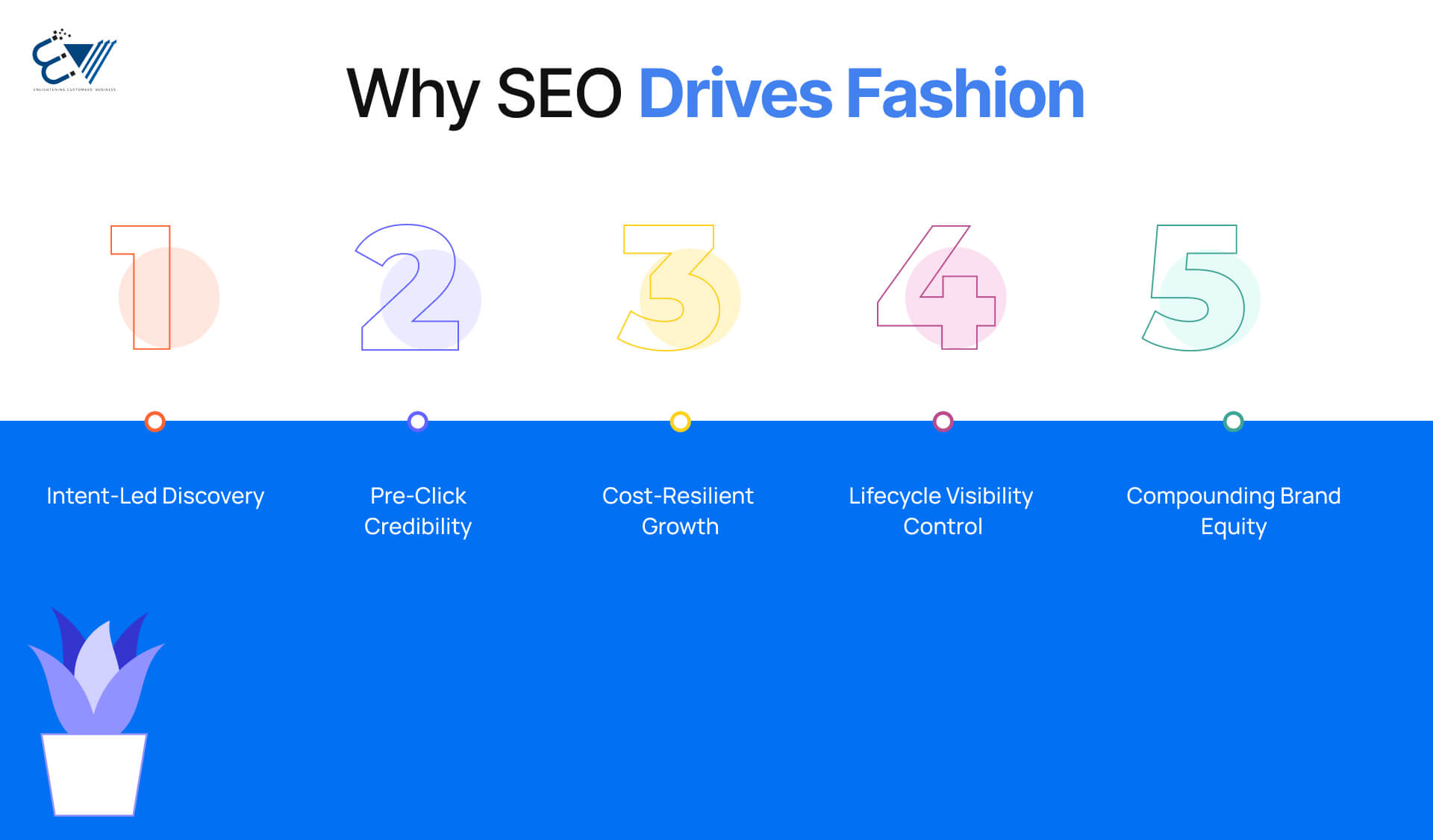
Fashion discovery often begins elsewhere, but evaluation almost always happens on search. Users compare styles, price ranges, fabrics, and alternatives before committing. SEO for fashion places your brand inside this evaluation window. Without it, the brand remains inspirational but commercially absent.
Consumers subconsciously associate search visibility with legitimacy. When a fashion brand appears repeatedly across category and product level queries, it signals scale and stability. SEO for fashion brands strengthens this perception long before users interact with campaigns or creatives.
This is an uncomfortable truth many brands learn late. Authority is inferred, not announced.
Fashion is one of the most competitive ad markets globally. As more brands compete for the same attention, paid acquisition costs increase while efficiency declines. SEO for clothing company growth introduces a stabilizing layer that reduces over dependence on short term media spend.
Fashion inventories move fast, but not every product sells immediately. SEO for clothing brand visibility ensures collections remain discoverable beyond launch windows, influencer cycles, or ad bursts. This improves inventory efficiency and extends revenue contribution.
Unlike campaign driven traffic, organic visibility builds memory. SEO services for fashion company strategies create cumulative exposure across seasons. Over time, this familiarity lowers friction, improves click through rates, and shortens decision cycles.
We see this repeatedly while delivering SEO services for fashion industry clients. Brands that treat SEO as infrastructure grow steadily. Brands that treat it as an add on struggle to sustain momentum.
Understand whether search visibility aligns with collections, lifecycle planning, and long-term inventory movement across seasons.
Review Strategy
After working with fashion businesses long enough, you stop looking at SEO as a growth hack. You start seeing it as infrastructure. The brands that scale steadily treat SEO for fashion ecommerce the way they treat supply chains or inventory planning. It is not exciting. It is essential.
Most fashion brands that struggle with SEO are not doing anything dramatically wrong. They are doing many small things inconsistently. Over time, those gaps compound.
Let us talk about the practices that actually hold up in real commercial environments.
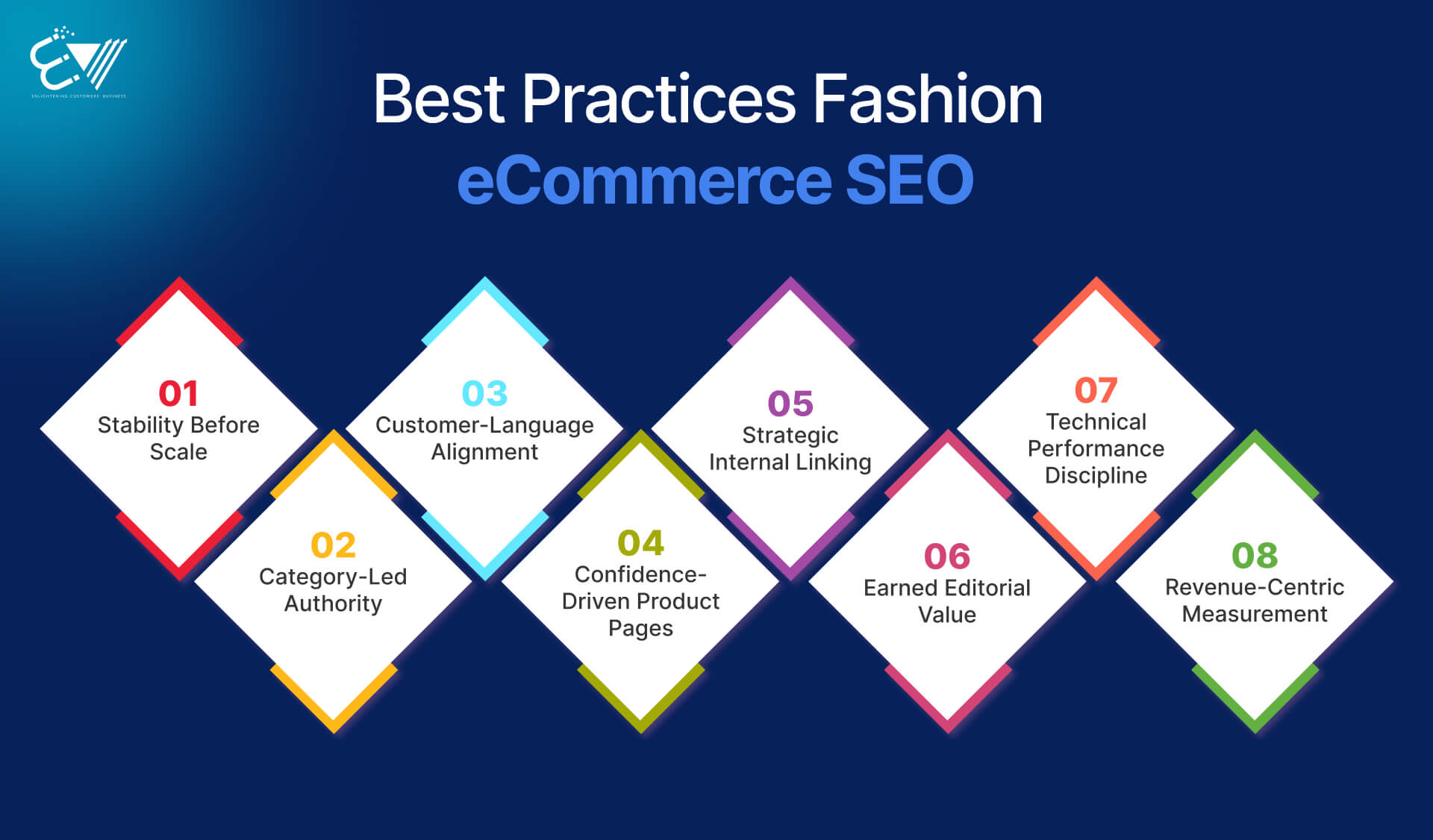
Fashion sites change more often than most industries. New collections, discontinued products, refreshed URLs, seasonal categories. SEO for fashion brands breaks down when structural decisions are made for speed instead of stability. Categories should not disappear every season. URLs should not change unless there is a business reason. Filters should be controlled carefully. SEO services for fashion industry work starts by reducing chaos before adding complexity.
This is usually the moment teams realize how much silent damage frequent changes cause.
In practice, category pages drive discovery, comparison, and assisted conversions. Yet they are often treated as visual galleries with minimal context. SEO for clothing brand performance improves when category pages explain scope, usage, and differentiation clearly. Search engines read these signals. So do users. This is where SEO for clothing company growth quietly accelerates.
A quick reality check. If category pages have no substance, search will treat them as thin navigation.
Internal naming conventions rarely align with search behavior. Customers search by problem, occasion, fit, fabric, or trend relevance. SEO for fashion ecommerce improves when content teams stop defending internal labels and start adapting to real queries. SEO services for fashion company execution often involves reworking copy that sounded correct internally but performed poorly externally.
This is uncomfortable work. It pays off.
High ranking product pages still fail when they do not answer practical concerns. Fit clarity, material expectations, care instructions, and usage context matter. SEO for fashion requires product pages to support decision making, not just visibility. Search engines increasingly reward pages that satisfy intent fully. This is where experience outperforms templates.
In physical retail, layout influences discovery. Online, internal links do the same. SEO for fashion brands strengthens when links connect related styles, collections, and editorial content naturally. This improves crawl efficiency and user engagement at the same time. SEO for clothing company strategies that ignore this leave performance on the table.
Pause here. If users wander without direction, search engines notice.
Not every piece of content needs to sell directly. It does need to justify its existence. SEO for fashion ecommerce works when editorial content aligns with search intent and supports product discovery indirectly. Trend analysis, styling guidance, and seasonal commentary attract early stage demand. SEO services for fashion industry teams use this content to warm audiences before conversion.
Most SEO losses in fashion happen quietly. Duplicate URLs. Orphaned pages. Broken redirects. Faceted navigation spirals. These issues rarely cause immediate drops. They erode performance over months. SEO for fashion brands requires ongoing technical hygiene, not reactive fixes.
This is the work no one sees until it is ignored.
Rankings look impressive in reports. Revenue impact matters more. Mature SEO for fashion ecommerce tracks assisted conversions, engagement quality, and visibility across priority categories. These signals show whether SEO supports real growth or just surface metrics.
One final operational note. For fashion brands investing in content, consistency matters more than volume. Publishing two to four strong pieces per month tends to outperform sporadic bursts. This rhythm supports authority without exhausting teams.
These practices are not theoretical. They come from watching what survives seasonality, competition, and budget pressure. Once this foundation is in place, advanced tooling and AI insights enhance results instead of compensating for weak fundamentals.
Inside agencies, AI did not arrive as a revolution. It arrived as a relief. Less guesswork. Fewer debates driven by opinion. Faster clarity in an industry where timing matters.
In fashion eCommerce, SEO decisions often suffer from two problems. Too much data and too little confidence about what to act on. AI insights help cut through that, but only when they are used with restraint and experience.
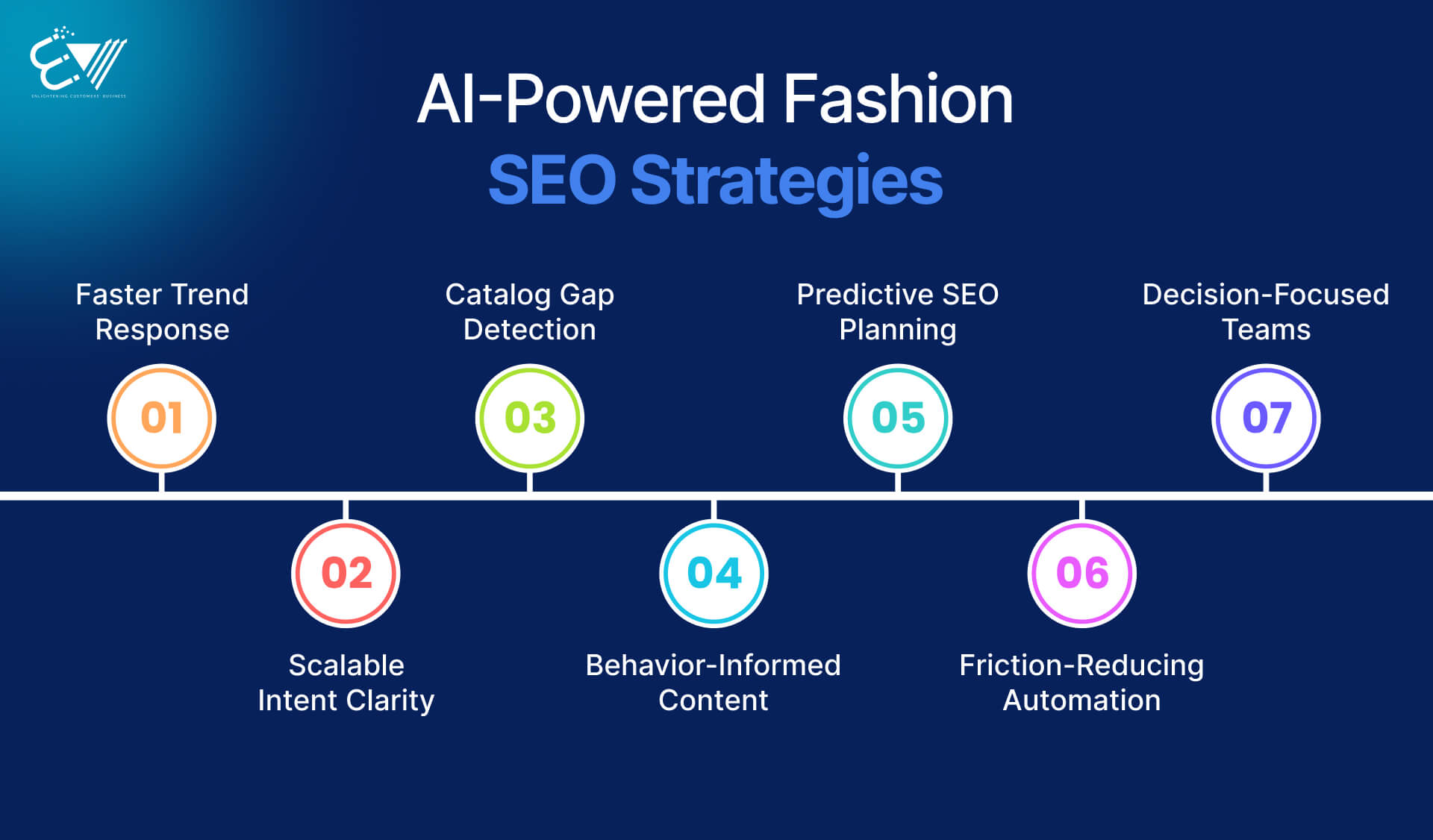
Fashion trends do not appear overnight in search results. They surface gradually through modifiers, rising category interest, and subtle query shifts. AI helps surface these early signals across large datasets that manual analysis misses. SEO for fashion ecommerce benefits when teams identify these movements before they peak, not after competitors flood the space.
Experienced teams know this matters. Acting late is the same as not acting at all.
Fashion queries are rarely simple. A single keyword can signal browsing, comparison, or readiness to purchase. AI helps classify intent patterns across thousands of queries quickly. SEO for fashion brands improves when pages are aligned accurately to these intent layers, reducing mismatches that hurt engagement and rankings.
This is where AI saves time, not replaces thinking.
Large fashion catalogs hide gaps. Missing category pages. Under explained collections. Thin product descriptions repeated at scale. AI driven audits highlight these blind spots efficiently. SEO services for fashion industry teams use these insights to prioritize work that moves visibility without spreading effort thin.
A small fix in the right place often outperforms broad rewrites.
AI analysis of user behavior helps identify where users hesitate, scroll, or exit. While SEO remains non personalized, these patterns inform how product and category content should be structured. SEO for clothing company strategies improve when pages are adjusted based on real engagement signals rather than assumptions.
Short pause. Data removes ego from the room.
Seasonality is predictable. Performance decay is not always obvious. AI models help forecast traffic shifts, ranking volatility, and content fatigue. SEO for fashion ecommerce teams that plan updates ahead of decline protect visibility that took months to build.
This is where AI changes planning conversations internally.
Metadata generation, internal link suggestions, and technical monitoring become faster with AI assistance. SEO services for fashion company execution becomes more efficient, but not hands free. Experienced teams review, refine, and contextualize outputs. AI speeds execution. Judgment still directs it.
The biggest advantage of AI is focus. By handling analysis at scale, it allows SEO teams to spend time on prioritization, creative alignment, and commercial impact. SEO for fashion brands becomes sharper when effort shifts from gathering data to acting on it.
One thing agencies learn quickly. AI amplifies whatever foundation exists. When fundamentals are strong, AI accelerates growth. When fundamentals are weak, AI exposes it faster.
Used properly, AI insights do not change what good SEO looks like. They make it easier to do consistently in an industry where consistency is rare.
Identify structural gaps, missed category opportunities, and visibility blind spots limiting commercial performance across your fashion ecommerce ecosystem.
Find GapsFashion brands rarely lose because their product is weak. They lose when they stop showing up where buying decisions are quietly made. Over years of working with fashion teams, one pattern repeats. Brands that treat SEO as a background task stay reactive. Brands that treat it as operating infrastructure stay visible when demand shifts.
SEO for fashion ecommerce is not about chasing rankings. It is about controlling discovery across categories, collections, and seasons. When structure is stable, language reflects real search behavior, and decisions are guided by data, search becomes predictable rather than volatile. That predictability protects margins, supports inventory movement, and reduces dependency on short term media spend.
This is where experience matters. A seasoned organic SEO agency brings process, restraint, and accountability into execution. Not louder strategies. Clearer ones. Over time, that discipline is what keeps fashion brands discoverable, trusted, and commercially relevant long after trends move on.