 Nidhi Thakur
 6 min
6 min


Every competitive B2B market has one quiet truth that rarely makes it into pitch decks. Most websites are competing for the same narrow strip of attention from the same decision-makers, using the same tired tactics. The result is predictable. Stagnant rankings. Flat pipelines. Boards asking uncomfortable questions.
SEO in this space is not about traffic volume or clever headlines. It is about credibility at scale. Buyers do not browse. They investigate. They compare. They wait. And when your site fails to show depth, clarity, and authority, they move on without a second thought.
After two decades of watching B2B companies rise and stall in search, one pattern holds. The winners do not chase hacks. They commit to fundamentals executed with precision. That is where the Best SEO Strategy for B2B Websites begins. With restraint, discipline, and an understanding of how real buying decisions actually happen.
B2B SEO becomes difficult the moment the stakes rise. Longer sales cycles mean every search touchpoint must educate, reassure, and position the brand as a safe choice. Competitive markets amplify this pressure. Everyone is publishing. Everyone claims expertise. Few actually prove it.
What complicates matters further is what most SEO playbooks ignore. In competitive B2B environments, search is rarely linear. It is shaped by multiple forces working at once:
Search intent fragments across these layers. One keyword can signal early research, vendor comparison, or internal consensus building. Miss that nuance, and rankings might arrive, but conversions will not.
Then comes the structural weight. Complex products. Dense service pages. Compliance language that cannot be simplified. Add this to competitive SERPs where authority is already entrenched, and shortcuts stop working fast.
This is where a well-planned B2B SEO approach stands out from general SEO tips. Putting together technical foundations, content depth, and trust signals into one system is key to success. Without that alignment, SEO becomes background noise. With it, search becomes a leverage that compounds quarter after quarter.
Identify gaps across keywords, content authority, and technical foundations that quietly limit visibility in competitive B2B markets.
Find Gaps
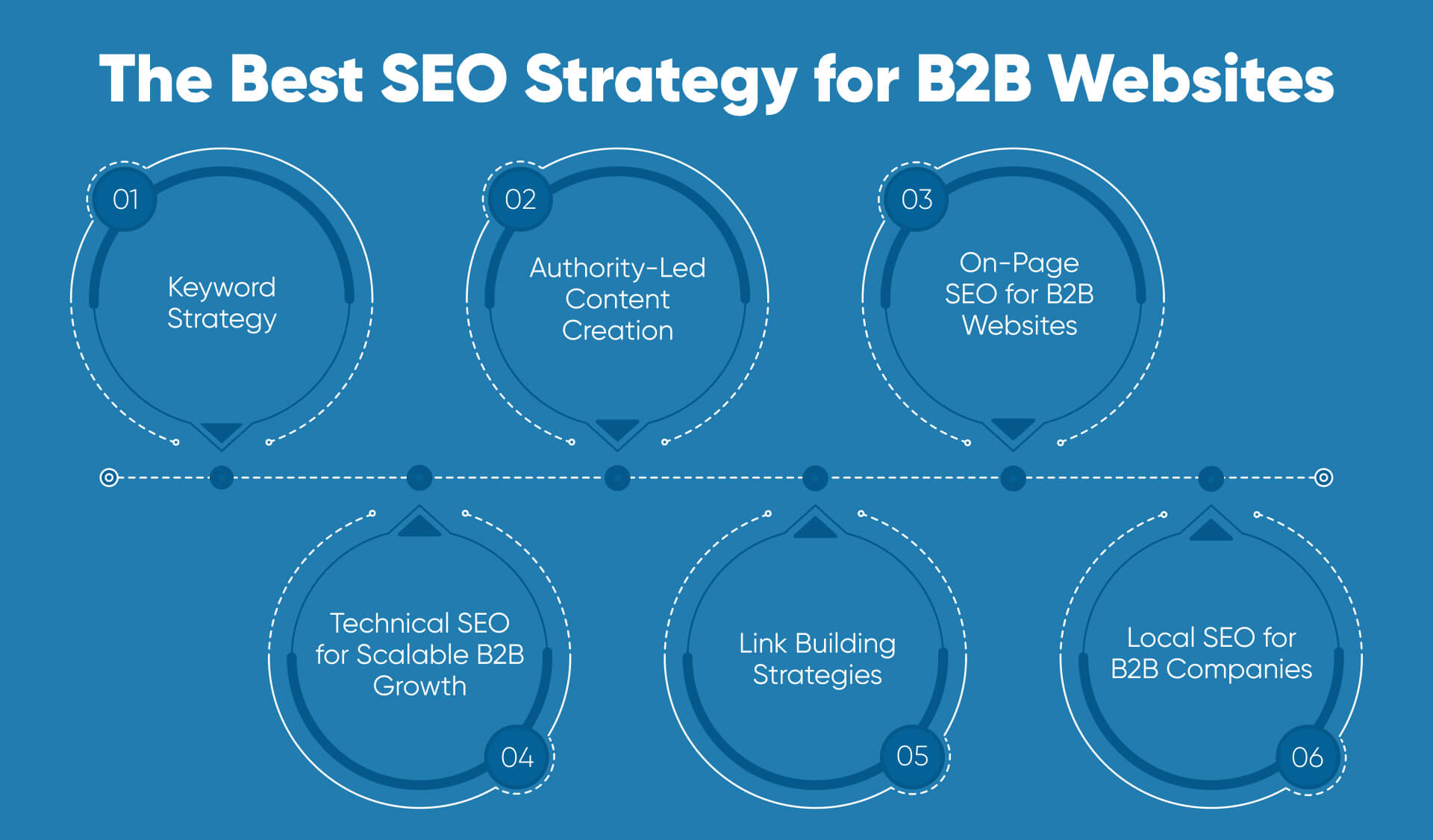
There is no universal playbook that works in crowded B2B markets. What works is a system. One that respects how buyers think, how search engines evaluate trust, and how competition actually behaves over time. The Best SEO Strategy for B2B Websites is not about doing more. It is about doing the right things with intent.
B2B keyword strategy starts with restraint. High volume terms look attractive but often hide vague intent. What matters more is relevance to real buying stages.
Effective teams focus on keywords tied to problems, use cases, and commercial evaluation. These terms may attract less traffic, but they attract the right people. This is where a mature b2b seo strategy quietly outperforms aggressive keyword chasing.
Content in B2B is not about publishing frequently. It is about publishing credibly. Buyers are looking for proof of experience, not surface-level explanations.
Authority-led content shows depth. It answers hard questions. It references real constraints. It demonstrates that the company understands the business realities behind the search query. This approach builds trust long before a sales conversation begins and is a core pillar of any serious seo for b2b strategy.
On-page SEO is where strategy becomes tangible. In competitive markets, small details compound.
Clear page structure, intent-matched headings, and internal linking that support buyer journeys all matter. Pages should guide readers logically from awareness to consideration, without forcing conversions too early. Strong on-page execution ensures that content is not only discoverable, but persuasive.
Technical SEO is often invisible until it breaks. In B2B, that invisibility can cost months of momentum.
Clean site architecture, crawl efficiency, page speed, and index control are foundational. As content libraries grow, technical debt grows faster. Scalable growth depends on systems that search engines can understand and trust consistently over time.
In B2B, links show that a business is real. Quantity is not as important as context and credibility.
Building links that work well relies on industry relevance, earned mentions, and positioning as a thought leader. A single link from a reliable authority in your field can be more valuable than dozens of generic placements. This is where experienced teams know how to develop a good reputation without using old link-building methods.
Local SEO is not just for storefronts. For B2B firms, it supports regional credibility and sales enablement.
Optimised location pages, local citations, and geo-relevant content help establish trust with regional buyers. In competitive industries, proximity and familiarity still influence decisions, even in global markets.
Increased visibility in competitive B2B markets: Your brand shows up all the time in places where serious buyers are looking, not hidden under noisier competition.
This is why the best SEO strategy for B2B websites is not spectacular, but it works every time. When done with discipline, it becomes a growth asset that competitors find hard to get rid of.
Evaluate whether your content demonstrates depth, credibility, and commercial relevance across complex B2B buying journeys.
Review ContentMeasuring SEO success in B2B is where many teams lose the plot. Rankings alone are comforting, but they rarely tell the full story. In competitive industries, progress shows up quietly before it shows up clearly.
The first signal is not traffic spikes. It is an intended quality. Are the right pages attracting the right visitors at the right stage of the buying cycle? When SEO is working, you see longer engagement on solution pages, deeper navigation paths, and repeat visits from the same organisations.
Pipeline alignment matters more than vanity metrics. Practical measurement focuses on:
Attribution in B2B is imperfect by nature. Sales cycles are long. Touchpoints are many. That does not make SEO immeasurable. It makes it strategic. Mature teams review performance monthly, but evaluate impact quarterly. They look for consistency, not spikes.
When done correctly, SEO becomes a forecasting tool. You can see demand trends forming before revenue arrives. That insight is where search moves from marketing tactic to growth intelligence.
In-house teams know the product. They know the market. What they often lack is distance. Competitive B2B SEO benefits from an external perspective that has seen similar patterns across industries, regions, and growth stages.
A specialised organic SEO agency brings pattern recognition that is hard to build internally, including:
More importantly, they bring process. Not just audits, but prioritisation. Not just content ideas, but execution frameworks that align with sales, product, and leadership teams. This operational discipline is where experienced partners like Edifying Voyages create measurable separation.
This is especially more useful for businesses who have offices in more than one place or region. Most teams don't expect competitive landscapes to change as quickly as they do:
This is where SEO for a B2B strategy benefits most from collaboration. Internal knowledge combined with external expertise creates momentum neither side can achieve alone. The outcome is not more activity. It is clearer focus, faster execution, and fewer costly detours.
Align SEO with buyer intent, trust signals, and scalable growth to outperform entrenched competitors over time.
Start StrategyIn competitive B2B markets, SEO rewards patience, precision, and experience. The companies that win are not louder. They are clearer, more credible, and consistently present when decisions are shaped. When strategy, execution, and measurement move in lockstep, search becomes one of the most reliable growth levers a business can use. Follow us on LinkedIn.
It is a long-term approach built around intent-driven keywords, authority-led content, strong technical foundations, and credible links. The focus is on influencing complex buying decisions, not chasing short-term traffic.
In competitive B2B markets, early signals appear within three to four months, but meaningful pipeline impact usually takes six to nine months due to longer sales cycles and higher trust thresholds.
Because B2B buyers research carefully and involve multiple stakeholders. Detailed, experience-backed content builds confidence and answers the questions that matter during evaluation.
Commercial keyword visibility, engagement on solution pages, assisted conversions, and organic influence on the pipeline are more valuable than raw traffic or rankings alone.
Yes. While paid channels can accelerate visibility, a well-structured organic strategy reduces dependency on ads and delivers more sustainable, cost-efficient growth over time.