
 Nidhi Thakur
 9.5 min


Here is a hard truth most law firms learn too late: winning in the courtroom means nothing if no one can find you online before they ever pick up the phone.
Civil litigation is one of the most competitive legal practice areas on the internet. People dealing with contract disputes, business conflicts, personal injury claims, or employment violations do not flip through directories or ask neighbours anymore. They go straight to Google, type in what they need, and call one of the first three names they see. If your firm is not sitting in that window, you are simply not in the conversation.
This is exactly why search engine optimization for civil litigation law firms has moved from a nice-to-have line item to a non-negotiable business strategy. The firms that understood this early are pulling in consistent, qualified leads every single month. The ones that ignored it are watching competitors take cases that should have been theirs.
At its core, SEO for law firms is the process of making your website visible to the right people at the right moment on search engines like Google. But for civil litigation practices specifically, it goes deeper than just ranking for generic legal terms.
It involves:
Done right, seo services for law firm growth in civil litigation means your website becomes your most reliable business development tool. Not your referral network. Not a billboard. Your website.
Discover where your firm stands in search visibility and uncover missed opportunities competitors are already capitalizing on today.
Get Analysis
The legal search landscape has shifted more in the last eighteen months than it did in the previous five years combined. If your firm has been coasting on an outdated website and a handful of directory listings, 2026 is the year that strategy finally stops working entirely.
Google's AI Overviews, ChatGPT search, and Perplexity are fundamentally changing how people find legal help. Instead of scrolling through ten blue links, potential clients are now getting direct answers pulled from websites that search engines consider authoritative and well-structured. If your content is not written to feed these AI systems with clear, credible, specific information, your firm will not appear in those answers at all. The firms that will dominate civil litigation search in 2026 are the ones being cited by AI, not just indexed by it.
More law firms are investing in digital marketing than ever before. Big companies with their own marketing budgets are going after high-value civil lawsuit keywords very aggressively. Regional firms that once relied entirely on referrals are now building content libraries and acquiring backlinks at scale. If your firm is not actively competing in search, you are not holding your ground. You are losing it.
Today's potential civil litigation client does not search for "lawyer near me" and call whoever appears. They research. They read practice area pages, compare firms, check reviews, scan blog posts, and look for any signal that a firm understands their specific situation. Search engine optimization for civil litigation law firms must account for this longer decision cycle by providing content that answers real questions at every stage of the client's research process.
Google's core updates in 2024 and 2025 were direct attacks on thin, low-effort content. Sites that published generic legal articles with no real expertise behind them got hit hard. What Google is rewarding now is demonstrable experience, topical depth, and genuine authority. For civil litigation firms, that means building a website that proves your firm knows this practice area inside and out, not one that just mentions it.
Read More: Ultimate Guide to SEO for Personal Injury Lawyers to Improve Visibility
Someone searching for a civil litigation attorney is rarely browsing casually. They have a problem. They need help now. SEO for law firms puts your firm directly in front of that person at the exact moment their intent is highest, which is something no billboard or TV ad can replicate with that level of precision.
If you are at the top of Google, it means that people trust you. Customers think that businesses that show up high in search results are real. When your business shows up in relevant civil litigation searches all the time with well-organized information and good reviews, people will trust you before they even talk to you.
Paid ads stop the moment you stop paying. SEO for law firms builds compounding momentum. A well-optimized practice area page or a deeply researched blog post can generate qualified inquiries for years without additional spend. That is the kind of return on investment that changes how a firm grows.
Most civil litigation clients want a firm that operates in their city or state. Local SEO ensures your firm appears in Google's map pack, local search results, and geo-specific queries. Owning local search in your market is often the highest leverage move a litigation firm can make.
Search engine optimization for civil litigation law firms is, at its most practical level, a competitive tool. Every position you move up in search results is a position a competing firm loses. The goal is not just visibility. It is dominance within your specific market and practice area.
SEO does not work in isolation. Strong organic rankings drive traffic that feeds your remarketing campaigns, improves your email list growth, and gives your social content more reach and context. Investing in seo services for law firm growth creates a foundation that makes every other marketing channel perform better.
A full-page ad in a legal directory or a regional TV spot can cost thousands of dollars with no way to tell if it worked. SEO builds on itself over time and gives you results that you can track and link to. For civil litigation businesses with small marketing budgets, it always gives the best long-term cost-per-lead of any channel.
Evaluate whether your current digital presence is built to capture, engage, and convert potential civil litigation clients effectively.
Find Out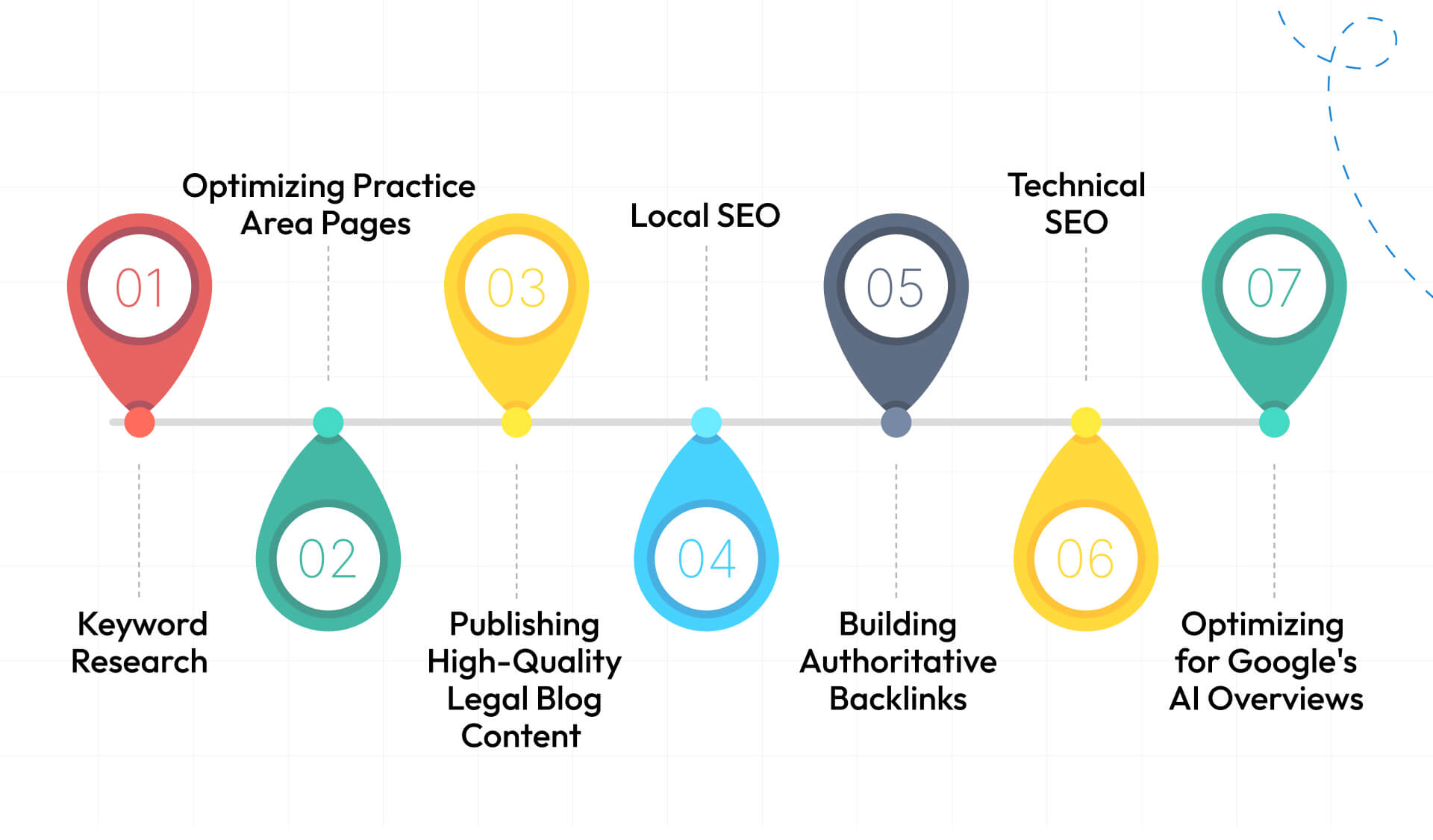
Effective keyword research for civil litigation goes well beyond high-volume head terms. It includes figuring out the exact words that your potential clients use, such as the types of cases they are involved in, the jurisdictions they are in, and the phrases they use in specific situations. What makes a keyword list different from a real content strategy is knowing what people are looking for when they type in each term.
Your practice area pages are your highest-value SEO real estate. Each page should be dedicated to a specific litigation type, written with enough depth to demonstrate genuine expertise, structured with clear headers, and built around the search terms your prospective clients are using. A single strong practice area page, done correctly, can outrank entire competing websites.
Consistent, well-researched blog content builds topical authority over time. For civil litigation firms, this means publishing content that answers the specific questions clients ask before they hire an attorney. Not generic legal overviews. Specific, useful, experience-driven articles that reflect what your firm handles.
Claiming and improving your Google Business Profile is just the beginning. Local SEO for civil litigation businesses also includes getting consistent citations in legal directories, getting reviews that are particular to a certain area, and making material that is specific to a certain area that tells Google that it is relevant to that area.
Backlinks from credible legal publications, bar association websites, local news outlets, and industry directories signal authority to search engines. For civil litigation firms, a focused link-building strategy built around genuine digital PR and thought leadership content will consistently outperform bulk link schemes that Google has learned to discount.
A slow website, broken internal links, duplicate content, or a poorly structured sitemap can quietly kill your search rankings regardless of how good your content is. Technical SEO audits should be conducted regularly to ensure your site is crawlable, indexable, and performing at the speed and stability Google expects.
To appear in AI-generated search summaries, your content needs to be structured clearly, written authoritatively, and directly answer the questions being asked. Using structured data markup, FAQ sections, and well-organized headers increases the likelihood that Google's AI systems pull from your site rather than a competitor's. This is one of the most important emerging priorities in SEO services for law firm visibility in 2026.
Read More: SEO for Divorce Lawyers
Most civil litigation firms do not have a visibility problem because SEO is hard. They have one because the same avoidable mistakes keep showing up across their websites. Here are the ones that cause the most damage.
Many firms optimize for broad terms like "attorney" or "lawyer" while ignoring the specific, high-intent phrases their actual clients are searching. A potential client dealing with a breach of contract dispute is not typing "law firm." They are typing something far more specific, and your content needs to meet them there.
A 200-word page that barely describes what civil litigation means tells Google nothing about your firm's depth of expertise. These pages rarely rank, and when they do, they rarely convert.
An outdated or unclaimed Google Business Profile, inconsistent name and address details across directories, and zero location-specific content are three of the most common issues found during law firm audits. In a practice area where geography matters enormously, this is a costly oversight.
Blog posts written purely to hit a publishing schedule, stuffed with keywords but offering no real insight, do more harm than good under Google's current quality standards. Every piece of content on your site should answer a genuine question or solve a real problem.
Duplicating the structure, language, or substance of another firm's website is both an ethical issue and an SEO one. Google does not reward sameness, and in a trust-driven industry like civil litigation, it can damage your credibility with prospective clients too.
Expecting results in thirty days. Search engine optimization for civil litigation law firms is a long-game investment. Firms that abandon their strategy at the three-month mark because rankings have not exploded are the same firms that will be paying for every single lead indefinitely through paid channels.
Knowing your SEO is working is not about gut feel. It is about tracking the right signals consistently and understanding what they are telling you.
Monitor how many visitors are reaching your site through unpaid search over time. A steady upward trend across your core practice area pages is one of the clearest indicators that your SEO for law firms' strategy is gaining traction.
Track your position for the specific terms that matter to your practice, including civil litigation keywords, location-based terms, and case-type phrases. Movement in these rankings, even incremental, reflects real progress.
Traffic without leads is a content problem or a conversion problem. Track how many contact form submissions, phone calls, and consultation requests are originating from organic search specifically.
For firms targeting specific cities or regions, tracking how frequently and prominently you appear in Google's local map results is essential. This is often where the highest-intent local traffic comes from.
Bounce rate and time on page. These behavioural signals tell you whether visitors are finding your content useful. If people are leaving your practice area pages within seconds, Google notices that too.
Backlink growth and quality. Keep an eye on how many and how good the websites that link to yours are over time. If your business's digital authority is growing in the right direction, you should see an increase in authoritative referring domains.
Explore how optimized content and search visibility can transform your website into a reliable client acquisition engine.
Book a CallIn 2026, the companies that will come up first in civil litigation searches won't always be the biggest or oldest. They were the first to take SEO for law firms seriously, build their online presence carefully, and stick with it for the long haul.
Search engine optimization for civil litigation law firms is not a technical afterthought. It is a core business development function. It determines whether a potential client in your city, dealing with exactly the kind of case your firm handles, finds you or finds someone else.
The investment required to do this well is far smaller than the cost of the leads you will keep losing without it. A focused, well-executed SEO strategy built specifically around civil litigation can transform your firm's online presence from invisible to indispensable.
If your firm is ready to stop leaving cases on the table, the right SEO services for law firm growth are the most direct path to getting there.
Because general marketing reaches everyone and converts few. Search engine optimization for civil litigation law firms puts your firm in front of people who are actively searching for exactly what you offer, now they are ready to hire.
Most firms see measurable ranking improvements within three to six months. Consistent lead flow from organic search typically builds between six to twelve months. SEO for law firms' rewards patience and consistency more than any other digital channel.
The search intent is sharper, and the client decision cycle is longer. People searching for civil litigation attorneys are dealing with active legal problems, which means content needs to be specific, authoritative, and case type focused to rank and convert effectively.
It depends on your market and competition level. Most firms investing in quality seo services for law firm growth spend between one thousand to five thousand dollars monthly and see stronger long-term returns compared to paid advertising at the same spend.
Yes, you can do basic chores, but it's hard to keep up with technical SEO, content, and link development without committed resources. Most businesses discover that hiring a legal industry expert to manage SEO for law firms gets them results faster and more consistently than doing it themselves.