 Nidhi Thakur
 6 min
6 min


Growth brings visibility challenges that are easy to underestimate. When a business operates from a single location, local search is relatively straightforward. One address, one set of listings, one competitive environment. That simplicity disappears as soon as multiple locations are introduced.
At that point, each location begins to behave differently in search competition, with the behavior varying from area to area. Search intent is no longer uniform. What performs well for one branch may not work for another.
Search engines do not evaluate multi-location businesses as a single unit. Each location is judged on its own relevance, proximity, and credibility. Without structure, visibility becomes inconsistent. Some locations perform well, others struggle, and the brand’s digital presence starts to fragment.
This is why a strong Local SEO Strategy for Multiple Locations matters more than many businesses expect, especially once expansion moves beyond the early stages.
Local search is meant to surface nearby businesses that match a specific need. With one location, this process is usually straightforward. Signals point to a single address, and search engines have less to compare.
That changes once multiple locations are involved. Each location enters a different local environment. Competition varies. Search behaviour varies by location. Even intent can shift slightly by area.
Because of this, search engines do not treat all locations equally. Performance in one area does not automatically carry over to another. Each branch is assessed on its own relevance and proximity, which can lead to mixed results across locations.
When the same optimization is applied everywhere, these differences are often ignored. This is when visibility becomes uneven, and rankings start to move without an apparent reason.
Businesses working with an organic SEO company usually see better outcomes when optimisation is adapted to each location rather than applied uniformly.
A Local SEO Strategy for Multiple Locations helps reduce that confusion. It gives search engines clearer signals about where each location belongs and when it should appear. Without that structure, growth in locations often leads to slower or inconsistent search performance.
Identify visibility gaps across locations using structured diagnostics that reveal inconsistencies, competitive pressure, and missed local demand at scale quickly.
Run Audit
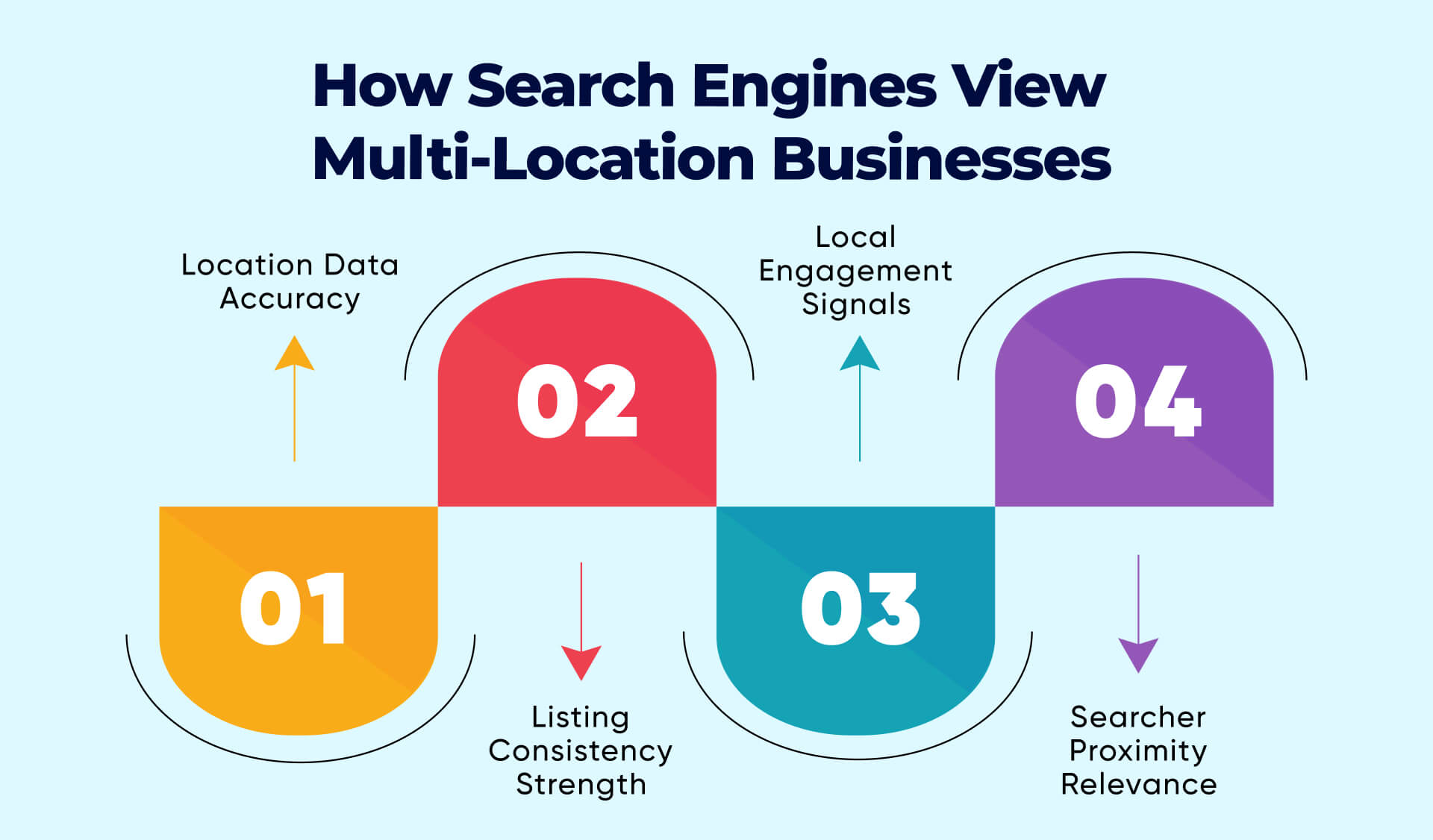
Search engines assess locations individually, even when they belong to the same brand. Brand-level authority can support visibility, but it does not replace local relevance. Each location still has to prove its place in local search results.
Signals are evaluated at the location level, including:
These signals help search engines decide which location is most relevant for a specific search. When they are weak, missing, or inconsistent, visibility begins to drop. This often shows up as uneven performance across locations rather than a complete loss of rankings.
A clear Local SEO Strategy for Multiple Locations helps prevent this by ensuring each branch sends distinct and accurate signals. It also reduces the risk of locations competing with one another in search results, which is a common issue as businesses expand.
Uniform SEO often feels like the safest option for growing businesses. The same content, structure, and optimization are applied across all locations to maintain consistency and reduce effort. While this approach may appear efficient, it rarely performs well in local search.
Local search is shaped by context. Competition varies from one area to another. Search behaviour differs by region. Even customer expectations can vary by location. When the same optimisation is applied everywhere, these differences are ignored, and relevance begins to weaken.
This does not mean brand consistency should be abandoned. Core messaging, standards, and positioning still matter. However, local SEO requires flexibility at the location level. Each branch needs the space to reflect its local environment while remaining aligned with the broader brand.
A strong Local SEO Strategy for Multiple Locations recognises this balance. It avoids copy-paste optimization and instead allows each location to compete on its own terms, without creating fragmentation or internal competition across the brand.
Location pages are often treated as simple placeholders, created to list an address and contact details. In reality, they play a central role in how search engines interpret and rank multi-location businesses.
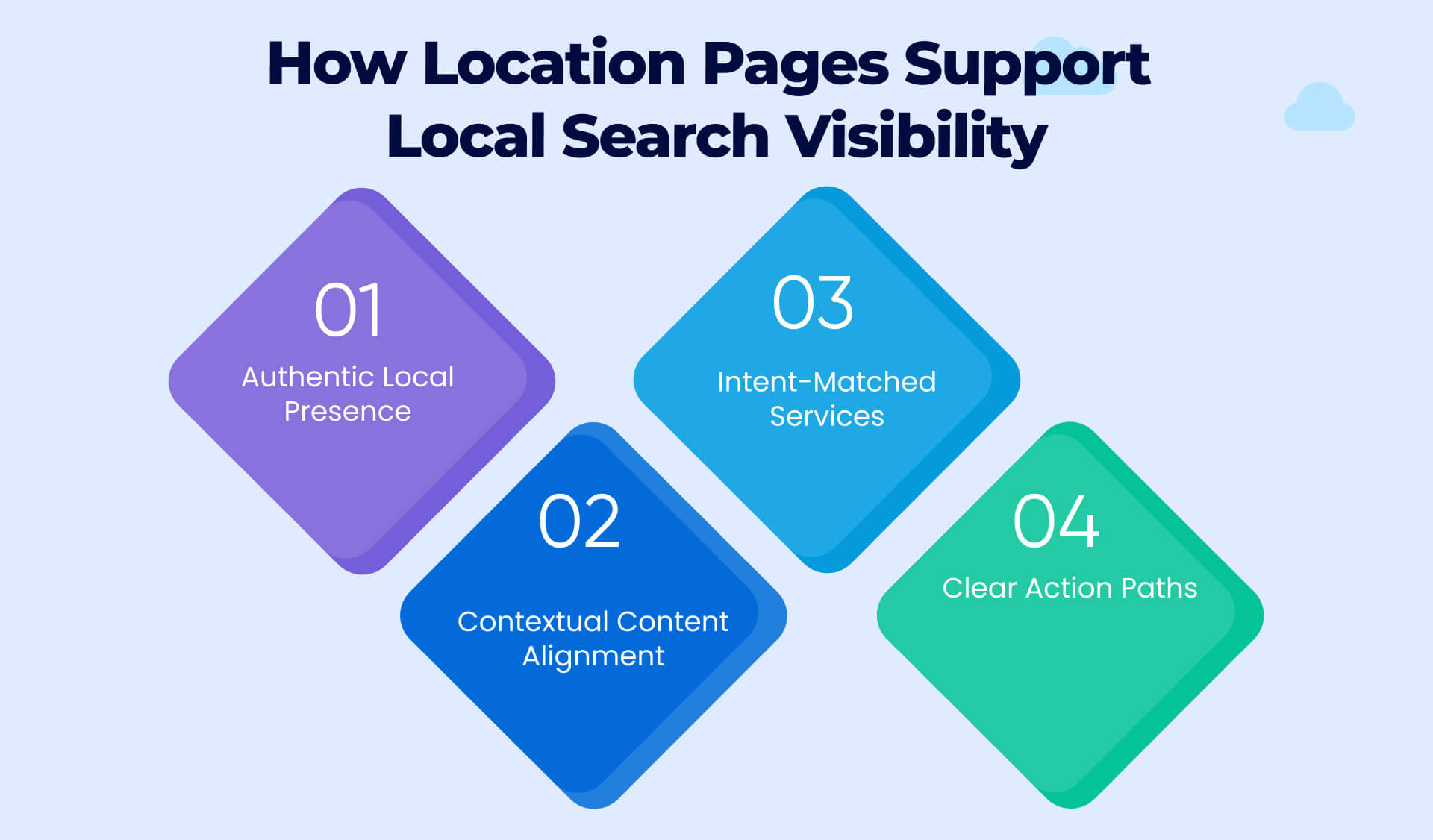
A well-built location page helps establish a clear physical presence. It signals that the business operates from a specific location and serves a defined local area. This clarity is essential for search engines when deciding which location should appear for a local query.
Effective location pages typically do the following:
When location pages are created with intention, they strengthen local relevance and trust simultaneously. Search engines gain clearer signals, and users find information without friction.
When location pages are rushed or duplicated across multiple locations, the opposite tends to happen. Relevance weakens, visibility becomes inconsistent, and performance across all locations can suffer rather than improve.
For multi-location businesses, location pages do not support content. They are a foundational part of sustainable local search visibility.
Scale confidently into new markets with a repeatable local SEO framework designed to prevent fragmentation and internal competition over time.
Plan ExpansionListing management becomes increasingly complex as businesses grow. Inconsistent details, outdated information, and duplicate entries are common problems once multiple locations are involved.
These issues rarely lead to immediate drops in visibility. Instead, they weaken credibility over time, making it harder for search engines to trust the information they find. This is where working with a structured local SEO company approach becomes essential.
A Local SEO Strategy for Multiple Locations accounts for this by implementing systems to maintain accuracy across platforms. This approach reduces reliance on manual fixes and helps keep information consistent as the business continues to expand. Consistency at this level is not optional. It forms the foundation of reliable local visibility.
Reviews influence decisions quickly. In local search, they are evaluated at the location level, not the brand level.
One location with weak reviews can underperform even if the brand has a strong reputation elsewhere. Over time, this imbalance affects overall visibility.
A structured approach ensures review activity is monitored and supported across locations, helping maintain trust without allowing individual gaps to grow unnoticed.
Local search is rarely exploratory. Most searches occur near the point of action. Proximity, clarity, and credibility matter more than long explanations.
When locations appear consistently with accurate information, decisions become easier. When visibility is uneven or confusing, potential customers move on quickly.
A reliable Local SEO Strategy for Multiple Locations reduces friction in this process by keeping information clear and accessible across all markets.
Without location-level data, optimisation often turns into guesswork. Performance can look stable on the surface while individual locations move in very different directions.
What works for one branch does not always translate elsewhere. Local competition, demand, and search behaviour vary, and those differences are easy to miss when performance is reviewed only at a broader level.
Looking at data by location brings those gaps into view. It becomes clearer where visibility is slipping, where effort is paying off, and where changes are not having the intended effect. This helps avoid broad decisions that fail to reflect what is actually happening on the ground.
As businesses scale, assumptions become less reliable. Location-level insight provides a steadier basis for decision-making and supports more controlled, sustainable growth in visibility.
Managing local SEO across multiple locations requires structure and patience. Edifying Voyages focuses on building systems that support clarity, consistency, and adaptability.
Rather than chasing isolated improvements, the emphasis stays on long-term performance. Each location is treated as part of a larger ecosystem, with SEO strategies aligned to business objectives and real-world constraints, whether operating alongside an internal team or as an offshore SEO company supporting global growth.
Get a tailored roadmap aligning every location with search intent, proximity signals, and scalable governance for predictable local growth outcomes.
Get RoadmapMulti-location growth brings opportunity but also complexity. Local visibility does not scale automatically, and without a clear framework, it can weaken instead of strengthen.
A strong Local SEO Strategy for Multiple Locations provides the structure needed to manage that complexity. It supports consistency, protects local relevance, and enables sustainable growth across markets.
For businesses operating across multiple regions, local SEO is no longer a supporting tactic. It is a core part of long-term digital performance.
A local SEO strategy for multiple locations focuses on optimising each business branch for its specific service area. It helps search engines clearly understand where each location operates and whom it serves.
Each location faces different competitors, search behaviour, and local intent. A separate approach ensures better relevance, visibility, and rankings in each market.
By improving visibility in local and “near me†searches, each branch attracts high-intent users. This results in more qualified traffic and stronger enquiry potential.
Location pages provide clear geographic signals to search engines. They prevent keyword overlap and improve local relevance for each business branch.
Once a business operates in more than one area, a dedicated local SEO strategy becomes essential. It supports scalable growth without affecting local visibility.