 Nidhi Thakur
 6 min
6 min


Growth looks positive on paper, but it often creates visibility issues that do not show up immediately. A business running from a single location usually has a clear search presence to manage. One address, one market, and one set of competitors keep things relatively predictable.
That balance changes once more locations are added. Each branch begins to face its own search conditions. Local competition differs, audience behaviour shifts, and search demand varies by area. A method that performs well in one region may produce little impact elsewhere. Over time, search visibility becomes uneven rather than stable.
Search engines also view each location separately. Rankings are influenced by how relevant, trusted, and locally connected each branch appears. Without a clear structure guiding this process, some locations gain visibility while others remain largely unnoticed. The brand’s presence starts to feel scattered rather than unified.
This is why a well-planned Local SEO Strategy for Multiple Locations becomes necessary as expansion continues. It helps maintain clarity across markets, supports consistent discovery, and prevents growth from weakening search performance instead of strengthening it.
B2B searches usually start with a problem. Sometimes it is a comparison. Sometimes it is part of an internal discussion before a decision is made. Very rarely is it casual. Unlike consumer searches, most B2B queries come from research, not impulse.
Small businesses deal with limits that cannot be ignored. Budgets are smaller. Teams are lean. The audience is often narrow and industry-specific. These realities shape how SEO works in practice.
At the same time, those limits create focus. There is less room for noise. Content tends to be more direct, and topics are chosen with clearer intent. When SEO follows this approach, small businesses often compete on relevance rather than scale. Being specific matters more than trying to be everywhere.
Discover whether your current SEO strategy supports genuine buying conversations or simply generates surface-level visibility.
Get Assessment
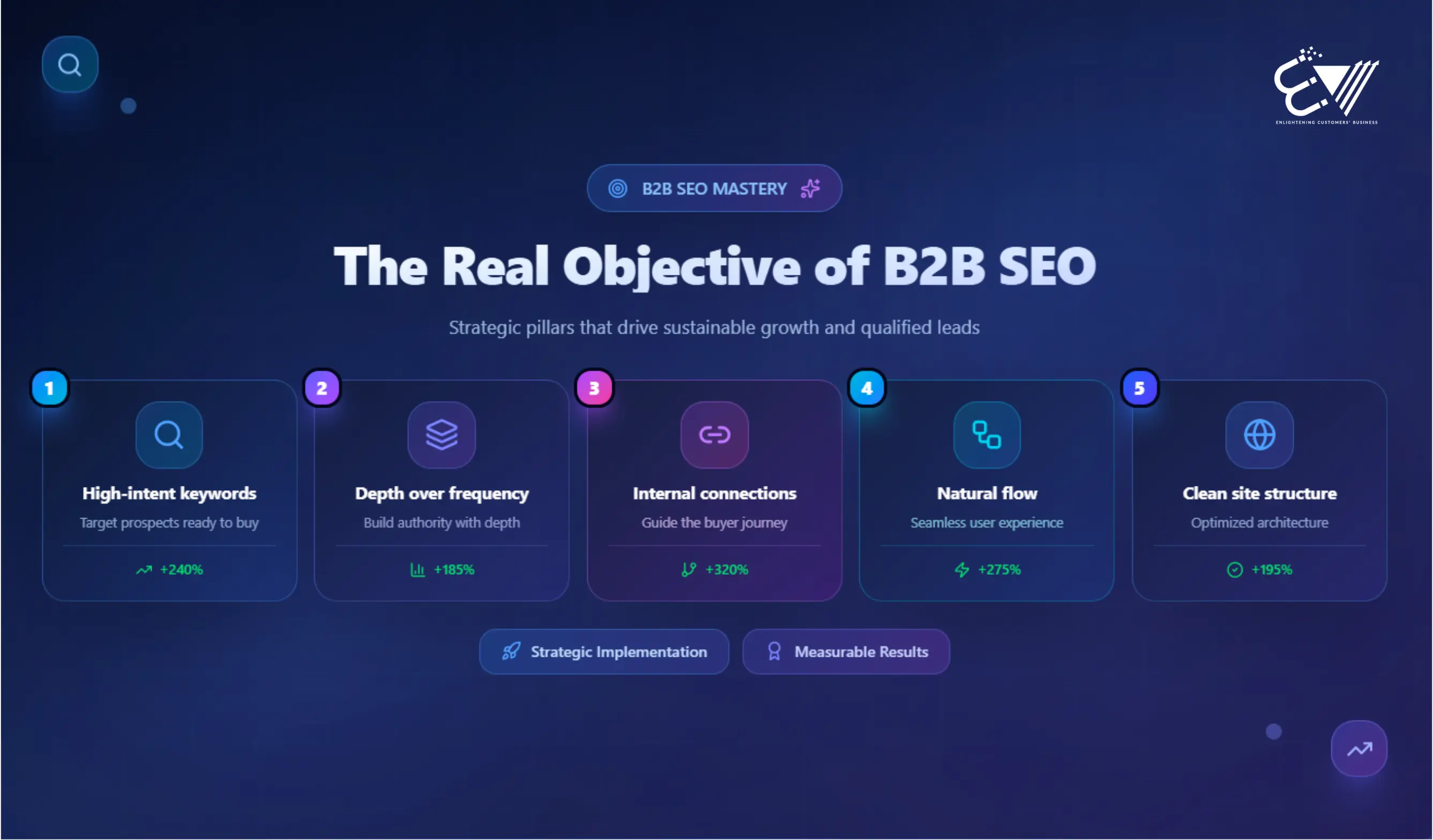
B2B SEO is often reduced to traffic numbers, but traffic on its own rarely explains business impact. In most cases, search visibility only matters when it connects to real buying conversations.
The real objective is alignment. SEO works best when it fits naturally into how businesses research, compare, and make decisions.
This alignment usually comes from a few practical factors:
When these pieces connect, SEO stops being about rankings alone. SEO works when it supports business conversations, not just search engines. This principle sits at the core of effective B2B SEO strategies for small businesses.
In B2B SEO, keyword research usually works better when it starts with real business problems rather than search volume. Most meaningful searches are tied to something not working, something being reviewed, or something being planned.
The keywords that tend to perform well in B2B often share a few traits:
Broad terms may look attractive on paper, but they rarely match how decisions are actually made. Small businesses that prioritise intent-led queries tend to reach decision-makers who are already considering options, rather than audiences still browsing at the surface level.
Publishing more content does not automatically build authority. In B2B, volume rarely carries the same weight as clarity and depth. What matters is whether the content reflects real understanding of the space it operates in.
Strong B2B content usually shows a few consistent traits:
When content is written from this perspective, it starts to do more than attract attention. Blogs, guides, and insights begin shaping trust early in the decision process. Long before a conversation takes place, content quietly influences how the brand is perceived.
Search engines reward consistency and depth of subject matter. Random blog publishing weakens impact.
Topical authority is built by:
This structured approach helps small businesses establish credibility faster and reinforces effective B2B SEO strategies in competitive niches.
Optimization should never disrupt readability.
Well-optimized B2B content includes:
SEO works best when it supports communication, not when it feels forced.
Small businesses do not need complex technical frameworks. They need reliability.
Core technical priorities include:
These elements ensure that content investments deliver long-term returns without unnecessary complexity.
Uncover how intent-led SEO can support sales pipelines, improve lead quality, and influence long-term business growth.
Start StrategyEdifying Voyages treats SEO as a growth system, not a checklist.
Unlike a traditional local SEO company focused only on visibility by location, the approach here connects local presence with intent-led discovery and long-term business relevance. The approach begins with understanding the business model, industry dynamics, and buyer behavior. SEO strategies are then built around visibility that converts, not just ranks.
Support includes:
This business-first execution allows small brands to compete with confidence, even in crowded markets.
AI is not used to replace thinking. It is used to sharpen it. This balance helps reposition the role of an offshore SEO company from execution-only support to a strategic partner contributing to quality, consistency, and scale.
At Edifying Voyages, AI enhances:
Human expertise drives strategy and storytelling, while AI strengthens accuracy and efficiency. This balance ensures originality, relevance, and scalability.
By combining human insight with AI intelligence, Edifying Voyages strengthens effective B2B SEO strategies for small businesses without compromising authenticity.
This perspective aligns more closely with how an organic SEO company measures progress, where sustainable growth and intent-driven visibility matter more than short-term spikes. SEO success in B2B is measured through business impact, not vanity metrics.
Meaningful indicators include:
SEO becomes valuable when it supports revenue, credibility, and long-term brand equity.
Learn how structured content, topical authority, and intent alignment create sustainable B2B search performance.
Explore GrowthMany small businesses struggle because of:
Avoiding these pitfalls is essential for sustainable results.
SEO remains one of the most powerful growth levers for small B2B businesses. When executed with strategy and patience, it builds authority, trust, and consistent demand.
By focusing on intent, expertise, and structure, effective B2B SEO strategies for small businesses create a competitive edge that compounds over time.
With a strategic mindset and AI-powered intelligence, Edifying Voyages helps businesses turn SEO into a long-term business asset, not just a marketing channel.
B2B searches usually come from ongoing work, planning, or evaluation. Most queries are tied to real problems, not casual browsing, which changes how keywords and content are handled.
High traffic alone rarely means much in B2B. What matters more is whether the search visibility connects with people who are already discussing solutions internally.
Yes, but not through volume. Smaller businesses tend to perform better when SEO focuses on specific topics, clear intent, and practical relevance rather than scale.
Content builds trust when it reflects a real understanding of industry challenges. Overly generic or promotional material usually fails to support serious decision-making.
Success is usually seen in lead quality, page engagement, and whether SEO supports sales conversations. Rankings matter less when business outcomes improve.